
We Just Published 100+ Free AI Skills for Commercial Real Estate. Here's the Reason Why.
Free library of 100+ AI skills for commercial real estate: acquisitions, leasing, asset management, and operations. Why we built it, and how to use it.
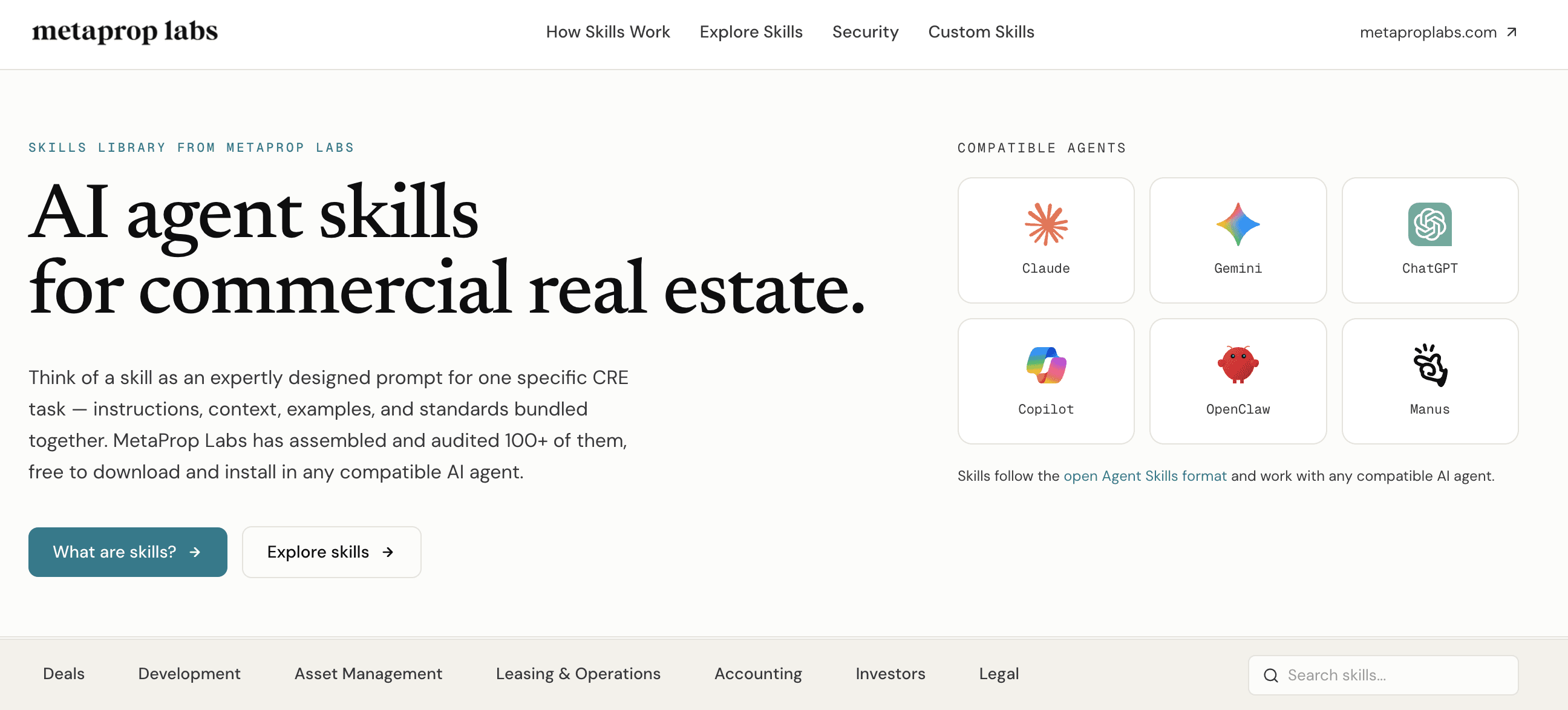
I'm Jeff Schacher, Chief AI Officer at MetaProp Labs. About a month ago we made a decision that felt a little counterintuitive. Today it's live: we just published 100+ AI skills built and curated for commercial real estate, and we made them available to all. Before I explain why, here's a quick summary of what a skill is:
AI Agent Skills are a new standard, adopted by Anthropic, OpenAI, and others, for extending what AI agents can do. A prompt tells the AI what to do once. A skill packages a repeatable business task with the context, standards, and verification a team needs to use it reliably.
A few examples of what that looks like in commercial real estate: an acquisitions analyst screening an OM on a 200-unit Phoenix apartment complex, flagging that the rent growth assumptions are 200 basis points above market before the deal reaches the investment committee. A portfolio manager turning operating reports from 18 properties into LP-ready variance summaries in two hours instead of two days. A lease administrator extracting every critical date, renewal option, and co-tenancy clause from a 40-page anchor tenant lease before a portfolio sale closes.
Now here's why we made them available.
AI Activity Isn't the Same as AI Capability
Every commercial real estate company I talk to is in a different place with AI. Some have built internal tools and aren't sure what to do next. Some are paying for Microsoft Copilot and wondering how long they should wait for it to get better. Some are experimenting with ChatGPT and Claude but haven't figured out how to make it useful for their teams. Some haven't started at all and are starting to feel the pressure.
Different starting points, but increasingly the same question: we have people using AI. So why doesn't it feel like we're building anything?
The Old Way to Build AI Tools
Building AI tools has always been top-down. An executive makes a request, a consultant or internal team member gets the assignment, and the employee closest to the work waits to see if what gets delivered matches what they actually needed.
That was the only option. Now it isn't. The companies that recognize the shift will move faster than the ones that keep routing everything through IT. The ones that miss it are about to spend the next six months building things that don't need to be built. Four months ago, all 10 of those automations would have needed a developer. Today, at least half are things your own people can handle directly in Claude.
When Employees Become the Builders
Skills changed who gets to build. If you can describe the task clearly, provide examples, and judge the output, you can now co-design a working version with Claude or ChatGPT directly. The employee who knows the task best is now the person who can build the tool to handle it.
That changes where AI capability comes from inside an organization. And for companies willing to create the right environment for it, the learning curve is faster than anything top-down ever produced.
The catch is that bottom-up without structure is just chaos. People experimenting in every direction, solving the same problems twelve different ways. The experimentation matters, but it needs a process layer: shared skills, common standards, a way to turn what works for one person into something the whole team uses. That's where firms figure out what AI is actually good at, and which workflows are worth standardizing.
Here's what most companies don't realize yet: if you're building internal AI tools, you're not doing an IT project. You're building a product. Your own internal product, for your own people. And building product well is a specific discipline: figuring out what users actually need, running discovery, iterating, operationalizing what works. It's a discipline most companies haven't needed before. Now they do.
Why Make the AI Skills Library Available to All?
First, breadth. AI in commercial real estate isn't a technology project or a single team's initiative. It touches every department, every asset class, every role in the firm. The library covers 100+ distinct tasks across the full business to make that visible. Wherever your people work, there's something here that applies to them.
Second, it's a menu. One of the most common things we hear from clients is some version of "we know we should be doing more with AI, we just don't know where to start." The library answers that. Browse it, find tasks that look familiar, and you've got your starting point. You don't need a strategy deck before you can take a first step.
Third, it's an invitation. The skills are open and available to all. What comes after them isn't: customizing them for your context, connecting them to your data, building the more complex automations that require real architecture, and knitting it all into something coherent. That's the work. The library is the beginning of that conversation, not the end of it.
From Skills to Systems
Take this maintenance triage skill. We helped set up something similar for a regional property management firm that was tracking maintenance requests manually and wanted something better. The skill reads incoming requests, drafts responses, flags urgent issues.
We told Claude to add a new category for gym equipment and route those to the fitness vendor. We tweaked the spreadsheet format to match what their team already uses. Set it to run every two hours. Posts new requests to their channel in Slack.
Nobody has to trigger it. It just goes. Today the data goes to a spreadsheet. Next week it could go to a database, or kick off a skill that drafts the vendor emails automatically.
That's the pattern. A skill becomes a workflow. A workflow gets connected to your data, your tools, your schedule. At some point you stop thinking about individual skills and start thinking about a system. One that knows your business, runs in the background, and gets more capable as your people build on it.
Most companies have been focused on the top-down half: infrastructure, data organization, enterprise agreements. But the other half has been mostly missing: enabling your people to experiment, build, and shape the AI layer from the ground up. The companies that move fastest will be the ones running both layers at the same time.
How to Start
If you want to see how skills work and you're not already using Claude or ChatGPT, sign up for a free Claude account and try one. Pick a workflow your team does every week, find the closest skill in the library, and run it.
If you want help building out your skills library or the broader AI systems that come next, you know where to find us.
Browse the library → Talk to us →
PS — Some companies are firmly in the Microsoft ecosystem for security or compliance reasons. That's a legitimate call. But some competitors in your same category, with the same concerns, have already put Claude or ChatGPT in the hands of at least a few people. Some have rolled it out broadly. You owe it to yourself to understand what your people could build in 10 minutes.
The Microsoft ecosystem can do some of this. You can build custom agents and give them skills. But that's still top-down. It goes through IT, it goes through procurement, and it skips the part where your own people figure out what's actually worth building. We work with companies across both. If you're committed to staying in the Microsoft ecosystem, we can help you get more out of it. But we'd still encourage you to understand what's possible outside of it.
Ready to Build AI Capability in Your Organization?
Let's discuss how AI can create competitive advantage for your organization.